
What Does 1/3 Mean in Nashville Numbers?
What does 1/3 mean in Nashville numbers? It means the 1 chord played with the third note of the key in the bass. In the key of C that is a C chord with an E underneath it, which you would see written as C/E on an ordinary chord chart.
The part that confuses people is that the two numbers do different jobs. The number on top is a chord. The number underneath is a single note, not a chord, and it tells whoever is playing the low end which note to sit on. Once you know that, every slash marking on a chart reads the same way.
Key Takeaways
- A slash in a number chart separates the chord from the bass note, so 1/3 is the 1 chord with the third note of the key beneath it.
- The top number is a chord and the bottom number is one note, which is the single most common thing beginners get backwards.
- Slash chords exist to smooth out the bass line, usually so it walks up or down by step instead of jumping.
- On guitar you can often play the plain chord and let the bass player handle the note underneath.
- A slash chord transposes exactly like every other number, so the chart still works in any key.
How to Read the Two Numbers
Take the symbol apart and it stops being mysterious.
Part of 1/3 | What it is | In the key of C |
The 1, before the slash | The chord you play | C |
The slash | A divider, nothing more | Nothing to play |
The 3, after the slash | One note from the scale, in the bass | E |
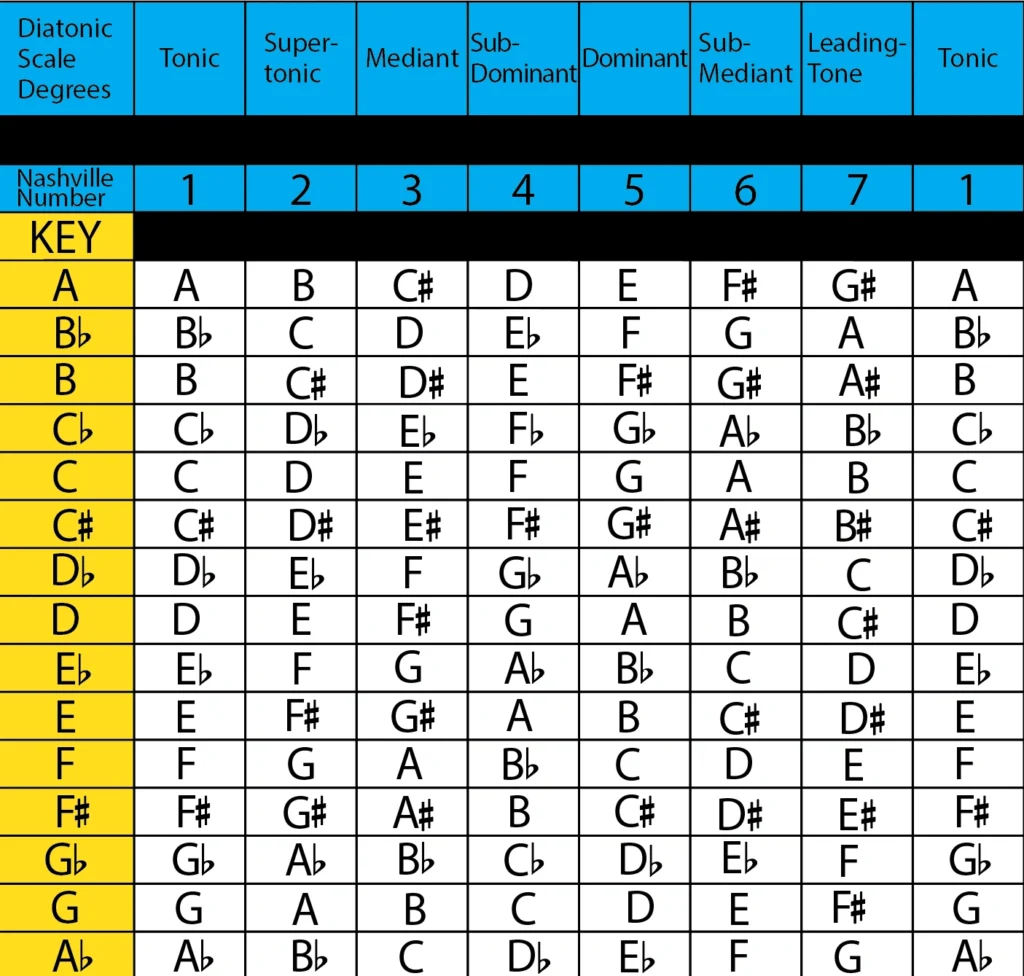
So 1/3 in the key of C is a C chord with an E in the bass. In the key of G it is a G chord with a B in the bass. The numbers do not change, only the key you count them from does.
If the numbering itself is still new, the step by step guide to reading a chart covers bars and markings before slash chords enter the picture.
Why Anybody Bothers
Slash chords exist to fix the bass line. Without one, the lowest note jumps around with the chords. With one, it can walk.
Play 1, then 4, in the key of C. The bass moves from C up to F, a decent jump. Now play 1, 1/3, 4. The bass moves C, E, F, which climbs one step at a time into the F. Same two chords, much smoother underneath.
The same trick works going down. A chart reading 1, 1/7, 6m, 1/5 gives you a bass line of C, B, A, G in the key of C, descending one step at a time while the chords above it barely move. That walking sound turns up constantly in country, worship, and pop writing, and the slash markings are what put it on the page.
I usually point this out by having a student play the progression both ways back to back. The difference is obvious by ear long before it makes sense on paper.
The Slash Chords You Will See Most
A handful cover the large majority of charts.
On the chart | Key of C | Key of G | What it usually does |
1/3 | C/E | G/B | Climbs from the 1 toward the 4 |
1/5 | C/G | G/D | Holds the bass still under a change |
1/7 | C/B | G/F# | Starts a descending bass line |
4/1 | F/C | C/G | Keeps the bass on the home note |
5/7 | G/B | D/F# | Leads back into the 1 |
6m/5 | Am/G | Em/D | Walks down out of the 6m |
4/5 | F/G | C/D | Sets up the 5 without the full chord |
Nothing on that list is advanced. These are ordinary chords with one note moved to the bottom, and most of them are already in your hands.
What Each Player Does With It
A slash marking does not ask everybody in the room for the same thing.
Who is playing | What they do with 1/3 |
Bass | Plays the third of the key, which is the whole point of the marking |
Keys | Puts that note in the left hand and the chord in the right |
Acoustic or electric guitar | Often plays the plain chord and lets the bass carry the note |
Drums | Nothing, since the marking is about pitch |
That third row surprises people. If a bass player is in the room, a guitarist who forces the low note on every slash chord can end up fighting them. When you are playing alone, though, the bass note is yours and it is worth finding.
On guitar some of these are easy and some are awkward. In the key of C, a 1/3 is one of the easy ones, because the note you need is already sitting there on the lowest open string. A 4/1 in the same key is less comfortable and often not worth the stretch in a band setting. That is a judgment call rather than a rule, which is why charts mark the note and leave the voicing to you.
Slash Chords Transpose Like Everything Else
This is where the system earns its keep. Both numbers are positions in the key, so both of them move together when the key moves.
On the chart | Key of C | Key of D | Key of A |
1 | C | D | A |
1/3 | C/E | D/F# | A/C# |
4 | F | G | D |
5/7 | G/B | A/C# | E/G# |
A chart reading 1, 1/3, 4 works in all three columns without a single mark being changed on the page. That is the same advantage covered in the post on shifting a song into a new key, and slash chords do not break it.

When the Bottom Is a Letter Instead of a Number
Some charts write the bass note as an actual letter, so you might see 1/E rather than 1/3. Both are in use and both mean the same thing in the moment.
The letter version is quicker to write and quicker to read if the key is settled. It also stops working the second somebody changes the key, because the letter does not move with the chart while a number does. If you are writing something out that might get transposed later, use numbers on both sides of the slash.
A flat can turn up on either side too, like b7/b3, which works exactly the way flats work everywhere else on a chart. The post on outside chords and what the flat sign does covers that marking in full.
Things Worth Knowing
- A slash chord is the same chord with a different note on the bottom, so the chord shape you know is still correct.
- The bottom number is almost always a note already in the chord or already in the key, which is why these sound smooth rather than strange.
- Charts sometimes drop the slash marking entirely and let the bass player decide, especially on a quick demo chart.
- A 4/5 is not a mistake and not two chords stacked, it is the 4 chord with the fifth note of the key underneath.
- Reading the top number first and the bottom number second is a habit worth building early, since it keeps you from freezing at speed.
- If a slash chord sounds muddy on guitar in a full band, let the bass have it and play the plain chord.
Where to Take This Next
I wrote Thadeus Beginning Electric Lead Guitar Featuring the Nashville Numbering System for the point where you can follow what is written on a chart and want to start playing something over it. It is a 128 page book covering the numbers, the shapes that sit underneath them, and how to build a lead line out of a progression rather than copying one note for note. Take it slowly with a guitar in your lap.

Frequently Asked Questions
Q: What does 1/3 mean in Nashville numbers?
It means the 1 chord with the third note of the key in the bass. In the key of C that is C/E, and in the key of G it is G/B.
Q: Is the bottom number of a slash chord a chord or a note?
A note. Only the number above the slash is a chord, and the number below it is a single bass note taken from the scale.
Q: What is the difference between 1/3 and 3m?
A 1/3 is the 1 chord with a different note underneath. A 3m is a completely different chord built on the third step of the scale.
Q: Do I have to play the bass note on guitar?
Not always. If a bass player is covering it, the plain chord usually sits better. If you are playing on your own, the low note is worth finding.
Q: Why do charts use slash chords at all?
To smooth out the bass line. A slash chord lets the lowest note step up or down instead of jumping with every chord change.
The Bottom Line
A slash on a number chart is one of the simplest markings there is once you stop reading it as a fraction. Top number is the chord. Bottom number is the note underneath. Everything else about the chart stays the same.
This week, play 1, 4 in the key of C, then play 1, 1/3, 4 right after it. Listen to what the bass does in the second version. That one comparison teaches the whole idea faster than any explanation on paper, mine included.