
How to Read a Nashville Number Chart Step by Step
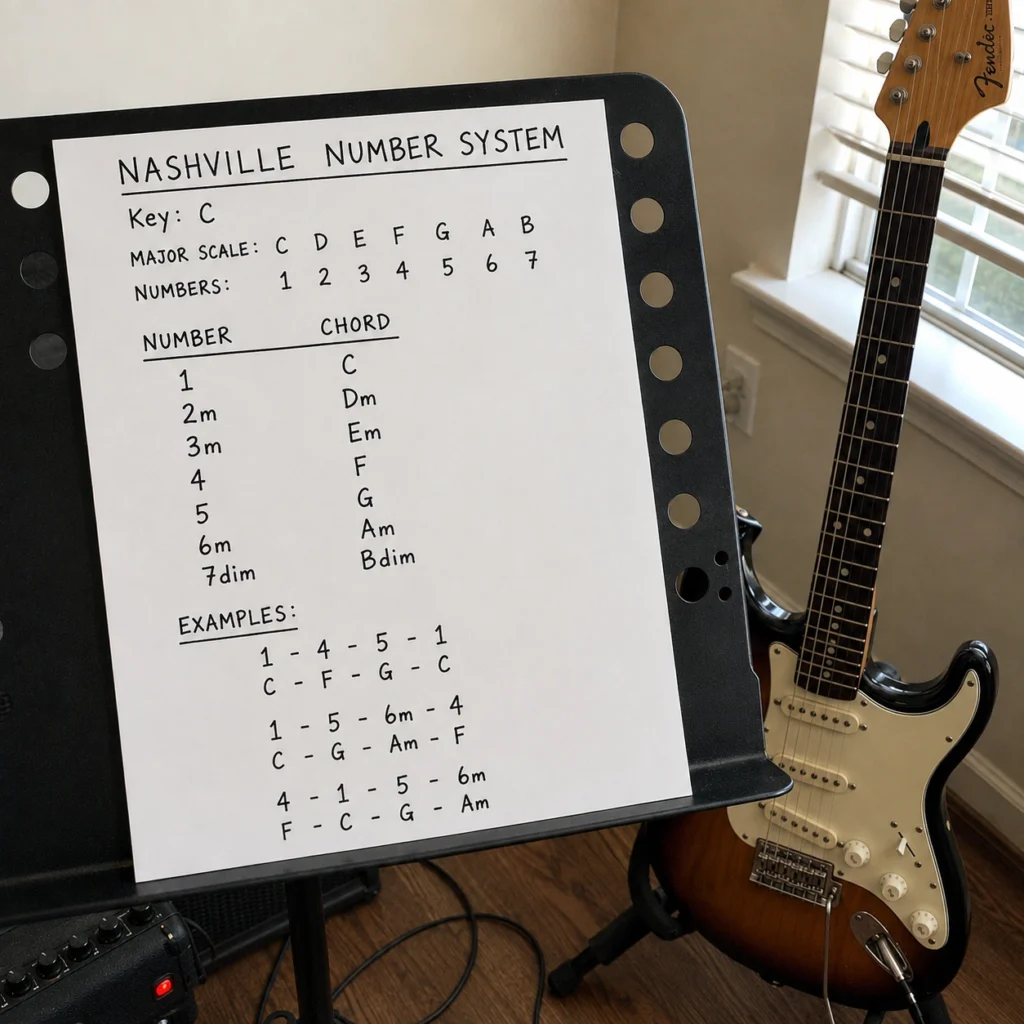
A Nashville number chart is a song written out with numbers in place of chord names. Each number stands for a chord built on one step of the major scale, so 1 is the home chord, and 4 and 5 are the two chords you lean on most after it. You read the numbers left to right exactly the way you would read chord names, and you play whatever those numbers work out to in the key the band calls.
That is the whole idea. Everything after this is detail, the chord qualities, the bar lines, the small marks that carry rhythm, and a short chart you can walk through yourself. I have taught this to players who had never read a chart of any kind, and most of them are getting through a simple one before the end of the first lesson.
Key Takeaways
- Numbers 1 through 7 stand for the seven chords built on a major scale, and 1 is always the key the song is in.
- In a major key the qualities run 1, 2m, 3m, 4, 5, 6m, 7dim, so a number with nothing after it is major and a lowercase m means minor.
- One chart works in every key, which is why a singer can change keys two minutes before downbeat and nothing on the page has to be rewritten.
- Bar lines and spacing carry the timing, and marks like diamonds, pushes, and split bars add limited rhythm detail.
- A number chart never shows fingering, melody, or lead lines, so you still have to know your chord shapes.
What a Number Chart Is and Where It Came From
Neal Matthews Jr., a singer with the Jordanaires, worked the system out in the late 1950s so his group could get vocal arrangements down fast in the studio. Charlie McCoy adapted it for rhythm section chord charts in the 1960s, and Chas. Williams compiled and published it in book form in 1988. You will hear it called the Nashville Numbering System as well, and both names point at the same thing.
The reason it stuck is simple. Session players needed one piece of paper that still made sense when the key changed. If you want the longer background before you start reading charts, I laid out the origins and the logic behind the system in more depth.
Step One, Match the Numbers to a Key
Nothing on the page tells you what key you are in. Somebody says it out loud, usually the singer, and from there the numbers turn into chords. Count up the major scale of that key and number the notes 1 through 7. Each of those notes is the root of a chord.
Here is the same set of numbers across four keys guitar players use constantly.
Number | Key of G | Key of C | Key of A | Key of E |
1 | G | C | A | E |
2m | Am | Dm | Bm | F#m |
3m | Bm | Em | C#m | G#m |
4 | C | F | D | A |
5 | D | G | E | B |
6m | Em | Am | F#m | C#m |
7dim | F#dim | Bdim | G#dim | D#dim |
Read that table across, not down. A chart that says 1, 5, 6m, 4 is G, D, Em, C in the key of G, and A, E, F#m, D in the key of A. Same chart, same numbers, different night.
Step Two, Read the Chord Qualities
The number tells you the root. What sits next to the number tells you the flavor of the chord.
What you see | What it means |
4 | Major chord, nothing added |
4m | Minor chord, the lowercase m is the only marker you need |
7dim | Diminished chord |
b3 | The root drops a half step, and the chord stays major unless something says otherwise |
1 with a 7 after it | The 1 chord played as a seventh chord |
1/3 | The 1 chord with the third of that chord in the bass |
That last one, the slash, trips up more beginners than anything else on a chart. The number before the slash is the chord your hand plays. The number after it is the note underneath, usually handled by the bass player, and on guitar you can often just play the chord and let the low note take care of itself.
Step Three, Read the Bars
A number chart is measured in bars, and one bar is one full count of the time signature. In 4/4, that is four beats. A number sitting alone in a bar means you hold that chord for the whole bar.
Charts group bars in fours, so a normal verse line looks like four numbers in a row across the page. When two numbers share one bar, they split it, two beats each in 4/4. Written charts show this with an underline joining the pair, and some players draw a small bracket instead. Either way, two numbers crowded into one bar means half a bar apiece unless the chart says different.
Say the bars out loud while you count. Four counts, next chord. That habit alone gets most players reading in time instead of reading and then guessing.
Step Four, Read the Extra Marks
People will tell you number charts carry no rhythm at all. That is not quite true. They carry less rhythm detail than standard notation, which is a different claim.
Mark | What it usually tells you |
A diamond drawn around a number | Hit the chord once and let it ring |
A caret or arrow before a number | Push the chord, playing it an eighth note ahead of the beat |
Two numbers underlined together | Split bar, the two chords share the bar evenly |
Slash marks after a number | Keep strumming in time, one slash per beat |
Charts are handwritten more often than not, and the person writing one has their own shorthand. If a mark on the page makes no sense to you, ask before the count off. Nobody in a session thinks less of you for asking, and everybody notices when you guess wrong.

Step Five, Play a Chart All the Way Through
Try this one. Key of G, 4/4 time.
Section | Bars |
Verse | 1, 6m, 4, 5 |
Chorus | 4, 5, 1, 1 |
Bridge | 6m, 4, 1, 5 |
In G that is G, Em, C, D for the verse, C, D, G, G for the chorus, and Em, C, G, D for the bridge. Play it once through slowly. Then call out the key of A and play the same page again, A, F#m, D, E, and so on down the chart. The second pass is where the system stops being an idea and starts being useful.
Once the shapes are under your fingers, run the same exercise against progressions you already know by ear. I broke down a handful of familiar songs by their numbers so you can check yourself against something recognizable.
What the System Will Not Do
A number chart does not show you where to put your fingers. It does not show melody, and it does not show a single lead line. If you cannot already play a barre chord, the chart telling you to play a 4 will not help you play one.
It also does not make standard notation or tab obsolete, and anybody who says otherwise is selling something. Tab is the better tool when you need the exact notes of a riff. Notation is the better tool when rhythm has to be exact. Numbers win when the key is unsettled and the arrangement has to move fast. I put the two formats head to head in a straight comparison of numbers and tab if you want to see where each one earns its place.
Things Worth Knowing
- Minor keys can be numbered from the minor root, so ask which reference the chart uses before you assume.
- Repeat signs, endings, and section labels work the same way they do on any chart, and none of that is unique to numbers.
- A chart with no time signature written at the top is almost always in 4/4.
- Handwriting varies enough that a chart written by one player may not match one written by another, and that is normal.
- Reading numbers and thinking in numbers are two different skills, and the second one takes longer.
- Learning to hear 1, 4, 5, and 6m by ear will speed up your reading more than any amount of practice with the page.
Where to Take This Next
I wrote Thadeus Beginning Electric Lead Guitar Featuring the Nashville Numbering System for the player who is exactly here, able to read a chart but not yet able to build lead lines from one. It is a 128 page book that walks through the numbers, the shapes that sit under them, and how to find a lead line inside a progression instead of memorizing one. Work through it at your own pace with a guitar in your lap.

Frequently Asked Questions
Q: Is the Nashville Number System hard to learn?
No. The core of it, numbers 1 through 7 mapped to the major scale, takes about ten minutes to understand. Getting fast enough to read a new chart on the first pass takes a few weeks of regular use.
Q: What does the little m mean on a Nashville number chart?
It means the chord is minor. A number with nothing after it is major, so 6m is minor and 4 is major.
Q: Do I need to know music theory to read a number chart?
You need one piece of theory, the major scale, and you need to know your chord shapes. Beyond that you can read charts for years without touching anything else.
Q: How do I change a number chart to a different key?
You do not change the chart. You change the key you count from, and the numbers turn into different chords automatically. That is the entire point of the system.
Q: Is the Nashville Number System the same as the Nashville Numbering System?
Yes. Both names describe the same method, and you will see them used interchangeably in books, charts, and studios.
The Bottom Line
Reading a Nashville number chart comes down to three things. Know what key you are in, know that a plain number is major and an m makes it minor, and count the bars in fours. Everything else on the page is a detail you can ask about in the moment.
This week, take one song you already play and write it out in numbers on a sheet of paper. Then play it from your own chart in a key you never use. That single exercise does more for your reading than an hour of studying charts somebody else wrote.
2 Responses