
Learn Nashville Numbers Without Reading Music
Yes, you can. Reading music and reading a number chart are two different skills, and the Nashville Number System was never built on the first one. A number chart has no staff, no clef, and no note heads, so nothing about it depends on knowing where a note sits on five lines.
This question comes up in almost every first lesson I teach on the subject. Somebody tells me they never learned to read, usually in an apologetic voice, and they expect that to be the end of the conversation. It is not even a speed bump, and the rest of this post explains why and shows you what you actually need instead.
Key Takeaways
- Number charts use numbers for chords rather than notes on a staff, so reading music is not a requirement.
- What you do need is the major scale, your chord shapes, and the ability to count bars in time.
- Self taught players often pick the system up faster than trained readers because they are used to listening rather than decoding.
- The one real limit is rhythm, since a number chart carries far less rhythmic detail than written music.
- You can read a simple chart the same day you start, which is not true of learning standard notation.
What Reading Music Actually Means
Reading music means turning written symbols on a staff into specific pitches and specific note lengths. It is a genuine skill and it takes time. A number chart asks for none of it.
What you are looking at | What it tells you | What it demands of you |
Standard notation | Exact pitches and exact rhythms | Reading the staff, key signatures, and note values |
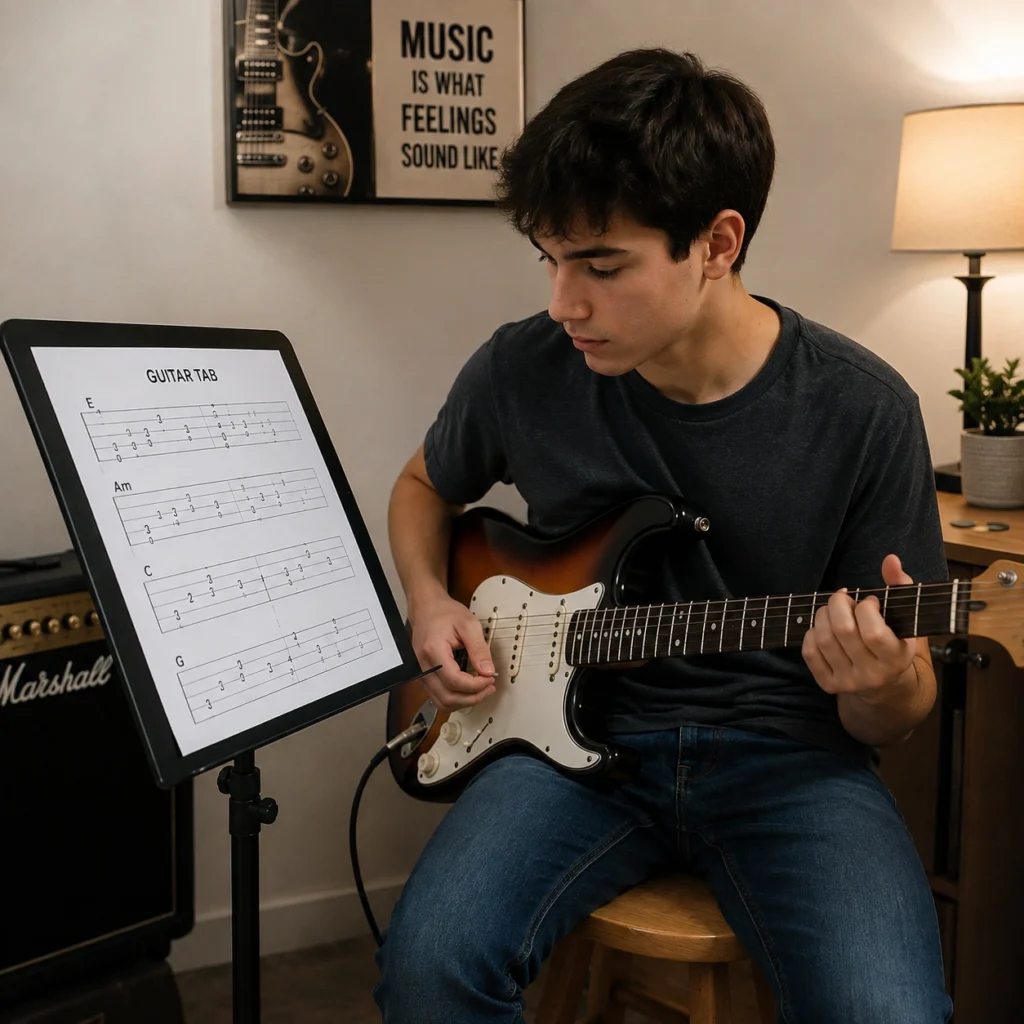
Guitar tab | Which fret and string to play | Almost nothing, but it locks a part to one position |
Number chart | Which chord to play and roughly when | Knowing the major scale and your chord shapes |
Three different tools for three different jobs. None of them cancels the others out, and any working player uses more than one. The number chart just happens to be the one with the lowest entry cost for somebody who plays by feel.
What You Need Instead
Here is the honest list. It is short.
What you need | Why it matters | How long it takes |
The major scale of a few keys | The numbers are just positions in that scale | An afternoon |
Your open and barre chord shapes | Numbers tell you which chord, never how to play it | However long it already took you |
Counting bars in four | Charts group music in bars and you have to stay in time | A few sessions with a metronome |
A working ear | Charts leave out detail that you fill in by listening | Ongoing, and it improves on its own |
Notice what is missing from that list. No note reading, no rhythm notation, no key signatures. If you can already play three chords and count to four, you have most of what the system asks for.
Where the Numbers Come From
You do not need theory in any formal sense. You need one idea, and it is this. Take the major scale of a key, count the notes from 1 to 7, and build a chord on each one.
Number | Note in the key of C | Chord |
1 | C | C |
2m | D | Dm |
3m | E | Em |
4 | F | F |
5 | G | G |
6m | A | Am |
7dim | B | Bdim |
A plain number is major. A number with a lowercase m after it is minor. That is the whole vocabulary for most songs you will play, and it does not change from key to key. The pattern 1, 2m, 3m, 4, 5, 6m, 7dim holds everywhere.
If you want the step by step version of turning that into an actual chart, I laid out the reading process in order, including bar lines and the small marks that carry timing.
Why the System Works This Way
The Nashville Number System, also called the Nashville Numbering System, came out of studio work rather than a classroom. Neal Matthews Jr., a singer with the Jordanaires, developed it in the late 1950s so the group could handle vocal arrangements quickly. Charlie McCoy adapted it for rhythm section chord charts in the 1960s, and Chas. Williams compiled and published it in book form in 1988.
Speed was the point. A room full of players needed something they could write fast, change fast, and read at a glance while the clock ran. Anything that required careful decoding would have defeated the purpose. That is why the system ended up simple enough for a player who never read a note to use on day one.
Where Not Reading Music Will Slow You Down
I would rather tell you this plainly than let you find out at a rehearsal.
Number charts carry some rhythm information. A diamond drawn around a number means hit the chord and let it ring. A mark before a number means push it slightly ahead of the beat. Two numbers underlined together share one bar. That is real information, but it is nowhere near the precision of written music.
So when a song has an unusual rhythmic figure, the chart will not spell it out for you. You get it by listening to the recording, or by hearing the band play it once. Players who read music have a small advantage in that moment. Players with good ears close the gap quickly, and most self taught musicians already have the ears.
The other limit worth naming is that a chart shows chords and nothing else. No fingering, no melody, no lead lines. Tab does that job better, and I compared the two formats and where each one wins rather than pretending one replaces the other.

How to Start This Week
Pick one key, C or G, and write out the seven chords with their numbers on a piece of paper. Play through them in order, up and back down, until the numbers and the shapes are stuck together in your head.
Then take a song you already know by heart and write its chords as numbers. Do not look anything up. Work it out against the list you just made. That single exercise teaches more than an hour of reading about the system, and it works whether or not you have ever seen a staff. If you need material to practice on, there are practice pieces and lessons on the site you can work through at your own pace.
Things Worth Knowing
- Learning the system does not close the door on reading music later, and the two skills sit comfortably side by side.
- Church and worship players often adopt numbers first because keys change so often in that setting.
- You will still need to know chord shapes, and the chart will never teach you those.
- Being able to hear the difference between a 4 and a 5 is worth more than any amount of studying charts on paper.
- Handwritten charts vary between players, so ask about any mark you do not recognize before the count off.
- Reading numbers and thinking in numbers are separate stages, and the second one takes a few months.
Where to Take This Next
I wrote Thadeus Beginning Electric Lead Guitar Featuring the Nashville Numbering System for players in exactly this position, comfortable with chords, never trained as readers, and ready to play something more than rhythm. It is a 128 page book that stays in numbers and shapes rather than notation, and it works through how to find a lead line inside a progression. Take it slowly with a guitar in your lap.

Frequently Asked Questions
Q: Do you need to read music to use the Nashville Number System?
No. The system uses numbers for chords rather than notes on a staff, so there is nothing on the page that requires reading music.
Q: Is the Nashville Number System easier than learning to read music?
Much easier, and much faster. Most players understand the basic idea in a single sitting, while reading standard notation fluently takes months or longer.
Q: What do I actually need to know before I start?
The major scale in a key or two, the chord shapes you already play, and the ability to count bars in time. Nothing beyond that.
Q: Can a complete beginner learn Nashville numbers?
Yes, though it helps to have a handful of chords under your fingers first. The chart tells you which chord to play, not how to play it.
Q: Does the Nashville Number System show rhythm?
Only in a limited way, through marks like diamonds, pushes, and split bars. For anything more detailed you listen to the song or hear the band play it.
The Bottom Line
Not reading music is not the obstacle you think it is. The Nashville Number System was built by working players who needed speed, and speed meant leaving out everything that required decoding. What is left is a short list of numbers, a couple of markings, and the chords you already know.
This week, write out the numbers for one key on an index card and keep it in your case. Then number one song you can play from memory. That is the entire entry fee, and you will have paid it in about twenty minutes.