
How to Play Lead Guitar by the Numbers, Not Tab
You learn a solo off a tab sheet. You get it clean. Then somebody calls the song a whole step down and every number on that page is wrong.
That is the problem with tab. It tells you a fret. It does not tell you where you are on the neck, what chord is sitting underneath you, or why any of those notes work. This is the part of the Nashville Number System almost nobody writes about, and it is how I teach lead guitar.
Key Takeaways
- Most writing about the number system covers chords. The same numbers work for single notes.
- A lead line written as numbers moves to any key without relearning a thing.
- You have to know which position you are in before the numbers mean anything.
- Chords go above the fretboard on a chart. The note sequence goes below it.
- Tab tells you a fret. Numbers tell you where you are and why the note fits.
Numbers for Chords, Numbers for Notes
When people talk about the number system, they almost always mean chords. The 1 chord, the 4 chord, the 5 chord. If you have read my post on how number charts compare to tab, that is the version you already know.
Here is the part that changes how you play lead. Those same seven numbers work for single notes.
In the key of A, the scale is A, B, C#, D, E, F#, G#. Number them 1 through 7 in order. Now every note on the neck has a number, not just every chord. The 3 is C#. The 5 is E. That is true anywhere on the fretboard and it is true in every key.
So when I write out a lead line, I am not writing frets. I am writing a sequence of numbers.

You Have to Know Your Position First
The numbers do not help you until you know where you are standing. That is the piece tab skips entirely.
I break the neck into five positions. In the key of A major, here is where they sit.
Position | Starts at | Covers |
1st | 2nd fret | 4 frets |
2nd | 5th fret | 4 frets |
3rd | 6th fret | 5 frets |
4th | 9th fret | 4 frets |
5th | 11th fret | 4 frets |
Those positions overlap. They share numbers with each other, which is exactly what you want, because it means you can cross from one into the next without stopping to think.
Once you know you are in second position in the key of A, you know your hand covers frets 5 through 8, and you know the number of every note under your fingers. That is the whole foundation.
How I Write It Down
A chart in my system has two halves.
The chords go above the fretboard. Those are the numbers you already know, like a 4, a 1, and a 5.
The note sequence goes below it. Those are the single notes of the lead line, written as numbers in the order you play them.
So a 4 above the board means the four chord. A 4 below it means the fourth note of the scale. The 4 is the root note of the 4 chord. Same number, two jobs, and the position on the page tells you which one I mean.
A Real Chart, Start to Finish
Here is a lead part I teach, written out the way I write everything.
Key of A major. The chords are 4, 1, and 5.
The chords on top of the chart are 4,1, 5 and 6.
You read the chart from left to right and top to bottom.
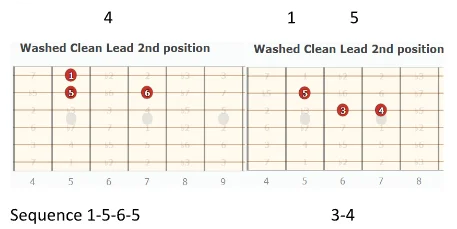
The line starts in second position, so your hand is covering frets 5 through 8. Read the number under each dot and play them in order. You are not counting frets. You are reading scale degrees.
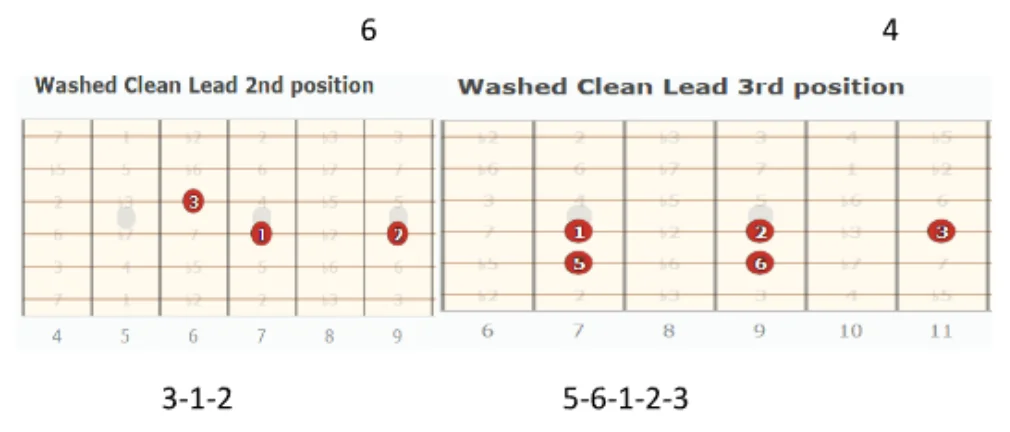
Notice the shift here. Third position starts at the 6th fret and covers five frets, and it overlaps with second position. Some of the numbers you just played are still sitting under your fingers. That overlap is how you move up the neck inside a phrase without losing your place.
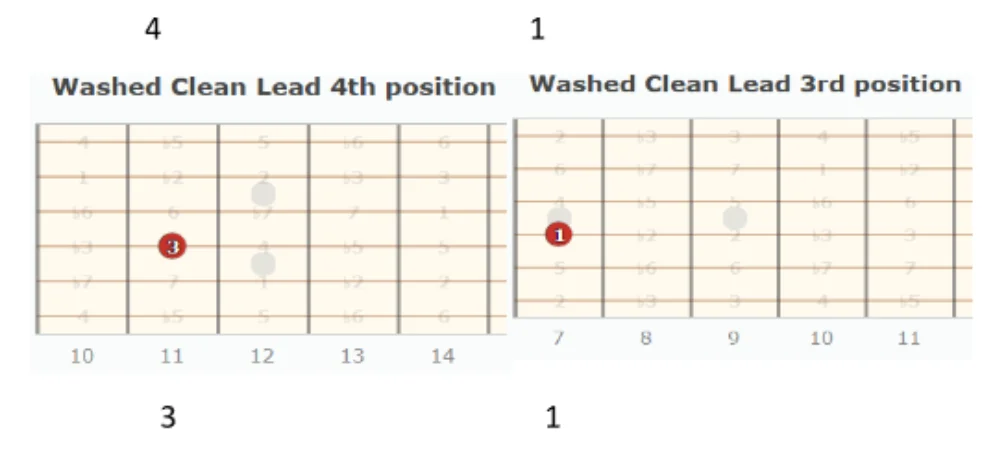
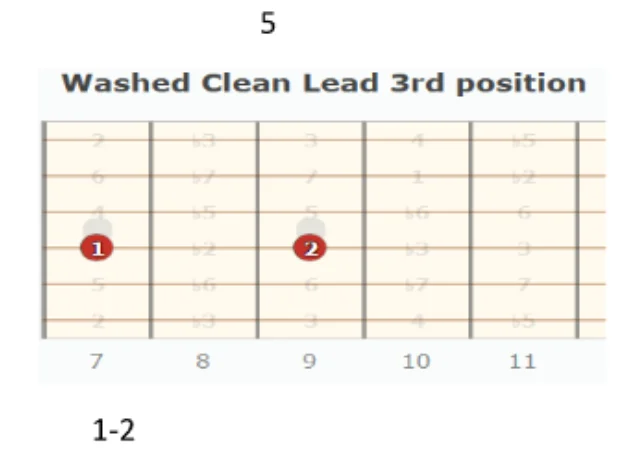
Lead part as I teach it, over a 4, 1, 5, 6 progression. Song written by Zach Williams.
Now Move the Whole Thing to G
Here is the payoff.
In the key of G, second position sits at the 3rd fret instead of the 5th. You move your hand down two frets and you play the exact same sequence of numbers. That is it.
The chords are the same numbers. The lead line is the same numbers. Nothing about what you learned changed, and you did not look anything up.
In tab, that is a completely different page. In numbers, it is a line you already know, moved.
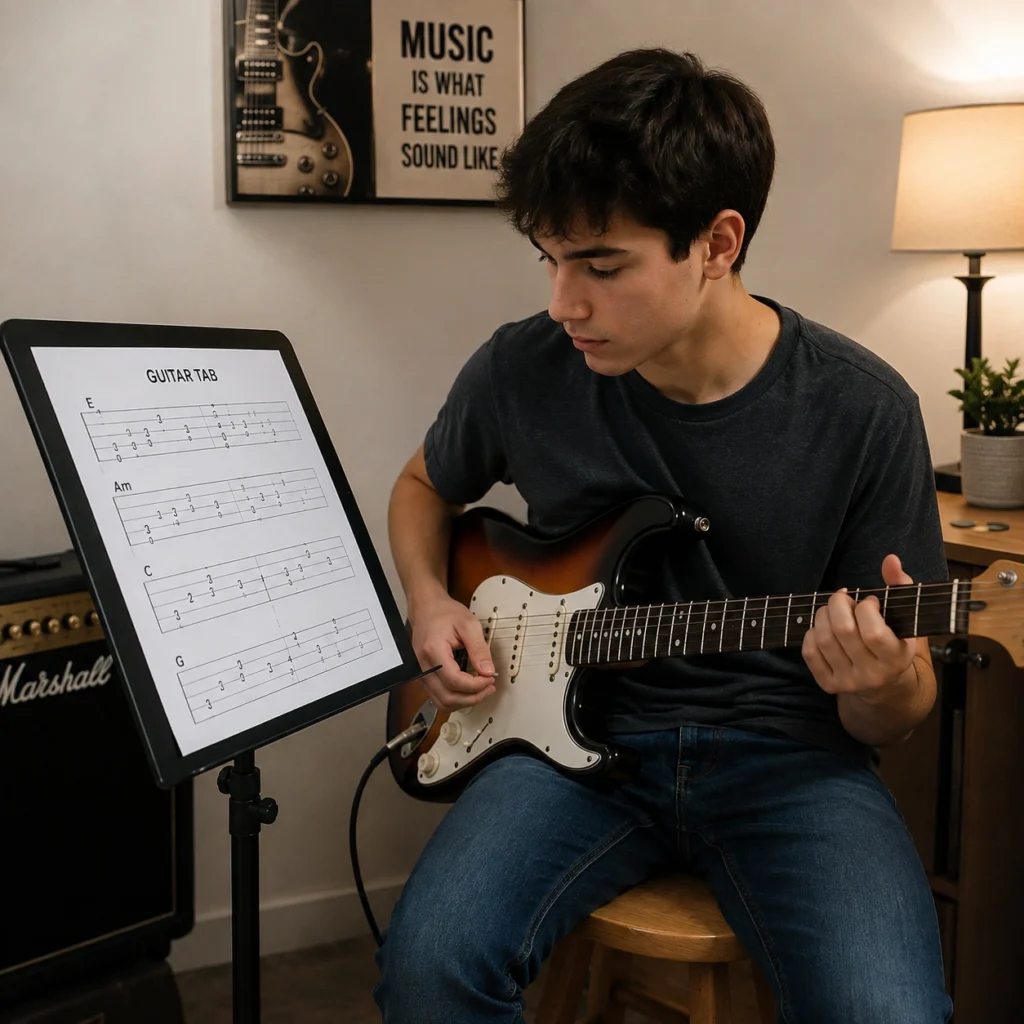
Why I Teach It This Way
Ask a tab-trained player what they are playing and they will tell you a fret number. Ask one of my students and they will tell you what position they are in and where the chords are inside it.
That difference shows up the first time they sit in with a band. When you know your position, you know your chord. When you know your chord, your lead line fits around it instead of fighting it. The melody and the harmony stop being two separate things you memorized.
It also means one line covers twelve keys. You are not learning a lick. You are learning a shape that travels.
Things Worth Knowing
- The numbers stay tied to the scale degree, not to the fret. That is what lets the same sequence work anywhere.
- Positions overlapping is a feature. Shared numbers are how you move from one part of the neck to another mid-phrase.
- This works alongside chord charts rather than replacing them. The progressions you already know by number are the harmony your lead line sits on top of.
- You still need your chord shapes. Numbers tell you what to play, not how to fret it.
- Start in one key and one position. Spreading across the neck too early is the fastest way to get lost.
Where to Start
Two things, in this order.
First, learn the chords in first position. Not every chord on the neck, just the ones that live inside those four frets.
Second, learn the A major scale in first position, and learn the number of every note in it.
That is exactly how I start every new student, and it is the order the whole method is built on. Once those two are solid, a lead line stops being a set of frets to memorize and becomes a sequence you can read.
I wrote Thadeus Beginning Electric Lead Guitar Featuring the Nashville Numbering System to walk through all five positions this way. It covers the A major scale in every position, where the chords sit inside each one, arpeggios, third and sixth harmonies, and how to carry all of it into any other key.

Frequently Asked Questions
Q: Can you really use the Nashville Number System for lead guitar?
Yes, and this is the part most people have never seen. The system is usually taught for chord charts, but the same seven numbers work for single notes in the scale. Once you think that way, a lead line is a sequence of numbers instead of a set of frets.
Q: How do I know which position I am in on the neck?
Each position covers a fixed span of frets in a given key. In the key of A, first position starts at the 2nd fret, second position at the 5th, third at the 6th, fourth at the 9th, and fifth at the 11th. Once you know where your hand is, you know your position.
Q: Do I need to read tab to learn lead guitar?
No. Tab is one way to communicate a line and it is not the only one. Numbers carry more information, because they tell you how each note relates to the key rather than just which fret to press.
Q: How do I move a lead line into a different key?
Find where that position sits in the new key and play the same numbers. In A, second position is at the 5th fret. In G, it is at the 3rd. You move your hand and the sequence stays exactly the same.
Q: What is the difference between the 4 chord and the 4 note?
On my charts, chords are written above the fretboard and single notes are written below it. A 4 above the board is the four chord. A 4 below it is the fourth note of the scale.
The Bottom Line
Tab hands you a snapshot of one line in one key in one spot on the neck. Numbers hand you a map. You learn where you are, what is underneath you, and how the note you are playing relates to the key, and all of that travels with you into every other key you will ever play in.
Pick one position this week. Learn the number of every note in it. Then take a short line and move it to a second key without looking anything up. Once you feel that work, you will not go back to counting frets.