
How to Transpose a Song Using Nashville Numbers
Transposing with Nashville numbers takes two moves. Turn the chords you have into numbers based on the key the song is written in, then read those same numbers back in whatever key you need. The chart never changes, only the key you count from changes, and the chords fall into place from there.
That is why the system exists in the first place. Neal Matthews Jr., a singer with the Jordanaires, worked it out in the late 1950s so vocal arrangements could be handled fast in the studio, and Charlie McCoy adapted it for rhythm section chord charts in the 1960s. Chas. Williams later compiled it into book form in 1988. Every one of those people had the same problem you have when a singer says the song sits too low, and I have watched this trick save a rehearsal more times than I can count.
Key Takeaways
- Transposing means moving every chord in a song up or down by the same distance so the song sits in a different key.
- Nashville numbers do the work for you because a number stands for a position in the scale, not for a specific chord.
- The chord quality travels with the number, so a 6m stays minor in every key you play it in.
- You only need to memorize one thing, the pattern 1, 2m, 3m, 4, 5, 6m, 7dim, and then apply it to whatever key gets called.
- A capo can raise a song without changing your shapes, but numbers work in both directions and work for the whole band.
What Transposing Actually Means
A song written in G uses the chords built from the G major scale. Move that same song to the key of A and every chord shifts up by the same distance, keeping the relationships between them intact. The song sounds identical apart from being higher.
Singers ask for this constantly. A melody that sits comfortably for one voice can strain another, and the fix is almost never rewriting the melody. The fix is moving the whole song. The Nashville Number System, also called the Nashville Numbering System, was built so that move costs nothing.

Step One, Turn the Chords Into Numbers
Start with the key the song is already in. Count up the major scale of that key and number each note from 1 to 7. Then match every chord in the song to its number.
Say the song is in C and the chords are C, Am, F, and G.
Chord in the song | Position in the key of C | Number |
C | First note of the scale | 1 |
Am | Sixth note, minor chord | 6m |
F | Fourth note | 4 |
G | Fifth note | 5 |
You now have 1, 6m, 4, 5, and that is the song. Write those four numbers on the page and you can throw the original chord names away. If the numbering itself is new to you, the full breakdown of the system covers how the scale degrees are built before you start moving anything.
Step Two, Read the Numbers in the New Key
Now somebody calls a different key. Count up that scale instead and read the same numbers back.
Key | 1 | 2m | 3m | 4 | 5 | 6m | 7dim |
C | C | Dm | Em | F | G | Am | Bdim |
D | D | Em | F#m | G | A | Bm | C#dim |
E | E | F#m | G#m | A | B | C#m | D#dim |
F | F | Gm | Am | Bb | C | Dm | Edim |
G | G | Am | Bm | C | D | Em | F#dim |
A | A | Bm | C#m | D | E | F#m | G#dim |
Bb | Bb | Cm | Dm | Eb | F | Gm | Adim |
Take 1, 6m, 4, 5 across that table. In C it is C, Am, F, G. In A it is A, F#m, D, E. In F it is F, Dm, Bb, C. Same four numbers, same song, three different keys, and nothing on your page had to be erased.
Print that table and keep it in your case for a few weeks. After a while you will stop looking at it, because the pattern gets into your hands.
Step Three, Handle the Chords That Are Not in the Key
Most songs eventually use a chord that does not belong to the scale. Numbers cover those too.
What you see | What it means | Example in the key of C |
b3 | The third chord lowered a half step, major unless marked | E becomes Eb |
b7 | The seventh chord lowered a half step | B becomes Bb |
1/3 | The 1 chord with the third of that chord in the bass | C/E |
4m | The fourth chord played minor | F becomes Fm |
The rule that keeps you out of trouble is that the marking travels with the number. If a chord was minor in the old key it stays minor in the new one. If it was flatted it stays flatted. You are moving positions, not guessing at chords.
Numbers or a Capo
Guitar players usually meet transposing through a capo first, and a capo is a fine tool. It just solves a narrower problem.
Approach | What it does | Where it wins |
Capo | Raises the pitch while you keep the same shapes | Solo playing, or when you want the open string ring of a familiar shape |
Numbers | Tell you the actual chords in the new key | Playing with other people, dropping a key rather than raising it, or reading a chart cold |
A capo only moves in one direction, up. It also does nothing for the bass player, the keys player, or the horn section, all of whom need real chord names. I use both, often in the same song, and the numbers are what let me tell the rest of the band what is happening.
Try It on Something You Know
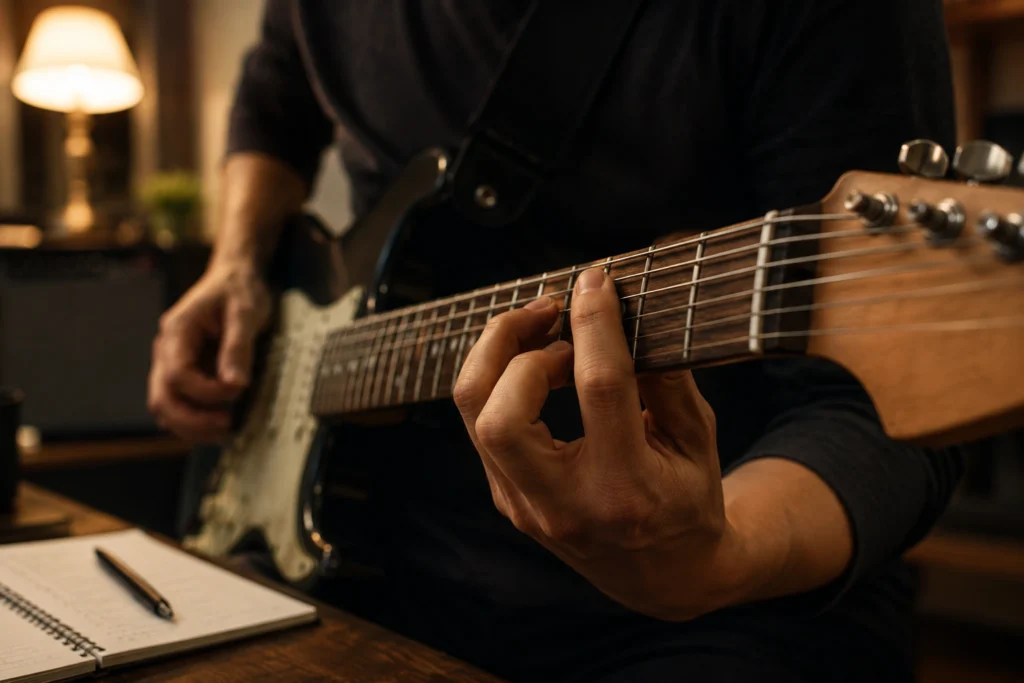
Pick a song you can already play without thinking. Write the chords out on paper, number them against the original key, then play it in a key you never use. Most players find the numbering easy and the playing awkward, which is the point of the exercise. The awkward part is a shape problem, not a theory problem, and it goes away with practice.
For a shortcut, a few well known progressions written out in numbers will give you material to test yourself against. Tab will not help you here, since it locks a part to one position on the neck, and I explained that trade off further in the comparison between numbers and tab.
Things Worth Knowing
- Transposing changes the chords, not the tempo, the feel, or the arrangement.
- A song can move down as easily as up, and singers ask for lower far more often than beginners expect.
- Some keys are harder on guitar than others, and Eb or Ab often calls for a capo alongside the numbers.
- The bass player is reading the same numbers you are, which is why calling out numbers on stage works better than calling out chord names.
- Horn players and keys players may prefer written chords, so hand them names once the key is settled.
- Practicing in the awkward keys is what turns transposing from a calculation into a reflex.
Where to Take This Next
I wrote Thadeus Beginning Electric Lead Guitar Featuring the Nashville Numbering System for the point where transposing chords stops being the hard part and building a lead line in a new key starts being the hard part. It is a 128 page book covering the numbers, the shapes that sit under them, and how to find the lead inside a progression instead of memorizing one line per song. Work through it with a guitar in your lap and take it at your own pace.

Frequently Asked Questions
Q: How do I transpose a song to a different key on guitar?
Number the chords against the key the song is in, then read those numbers back in the new key. A 1, 4, 5 in G becomes G, C, D, and the same 1, 4, 5 in D becomes D, G, A.
Q: Can I transpose a song without knowing music theory?
Yes. You need the major scale and your chord shapes, and nothing beyond that. The numbers handle the rest.
Q: Is it easier to transpose with a capo or with Nashville numbers?
A capo is faster when you are playing alone and moving the key higher. Numbers are better when you are playing with other people or moving the key lower, since a capo only raises pitch.
Q: What happens to minor chords when you transpose?
They stay minor. The chord quality is attached to the number, so a 6m is a minor chord in every key.
Q: Do I have to rewrite the chart when the key changes?
No. That is the whole reason the system exists. One number chart works in all twelve keys without a single mark being changed.
The Bottom Line
Transposing is the clearest argument for learning Nashville numbers. Once a song lives on the page as numbers instead of chord names, changing keys costs you nothing but a moment of counting, and it costs the rest of the band nothing at all.
This week, take one song you play often, write it out in numbers, and run it in three keys, the original plus two others. Do that with a metronome going so you are transposing in time rather than stopping to think. Three songs handled that way and you will not need the table anymore.