Nashville Number System vs Guitar Tab, Which to Learn
Here is the quick answer. Guitar tab shows you exactly where to put your fingers. The Nashville Number System shows you how chords relate to each other in a key. They are built for different purposes and they encode different information, which is why the question of picking one is the wrong question.
Key Takeaways
- Guitar tab is finger placement for fretted instruments. It does not teach you music theory or help you transpose.
- The Nashville Number System replaces chord letter names with numbers, so a chart works in any key without rewriting it.
- Neal Matthews Jr., a singer with the Jordanaires, developed the system in the late 1950s, and Charlie McCoy later adapted it for chord charts.
- Standard notation, tab, and the number system each do something the others cannot. None of them is obsolete.
- Beginners can learn the number system without reading sheet music or tab at all.
What Guitar Tab Actually Does
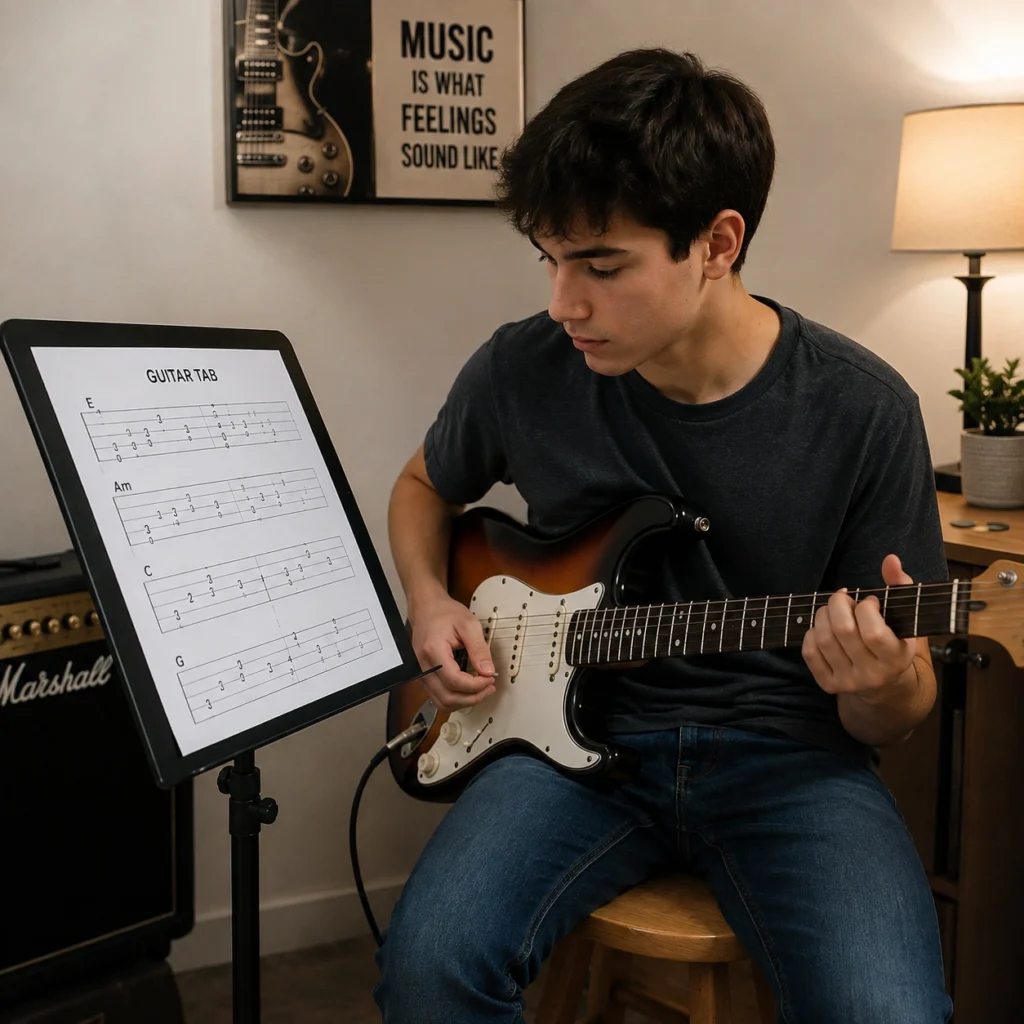
Guitar tab is a diagram of your guitar’s six strings. Each horizontal line stands for one string. The bottom line is the 6th string, the thickest one, usually tuned to E. The top line is the 1st string, the thinnest one, also tuned to E but two octaves higher. Numbers sitting on each line tell you which fret to press. That is the whole system.
One thing trips up almost everybody at first. The lowest sounding string appears at the bottom of the tab, even though it is the string closest to your chin when you are holding the guitar. Tab is drawn from the player’s point of view looking down at the neck, so low pitch sits low on the page.
Tab is useful for beginners because it requires zero theory knowledge. You do not need to know what key a song is in. You do not need to know what a scale degree is. You find the fret and you play the note.
That simplicity is also the limitation.
Tab does not tell you how long to hold a note. Some tab editors add rhythm marks above the diagram, but standard tab on its own gives you no duration information. Tab also does not transpose. If a band calls a song in G and you learned it in A, your tab is dead weight until you rewrite it or hunt down a new version.
Most importantly, tab never explains why a note is being played. This is where a lot of self-taught players get stuck. You can play a solo note for note off a tab sheet and still have no idea what scale it came from or how to use any of it in another song. Tab is a photograph. It shows you one moment, in one key, on one guitar.
What the Nashville Number System Actually Does
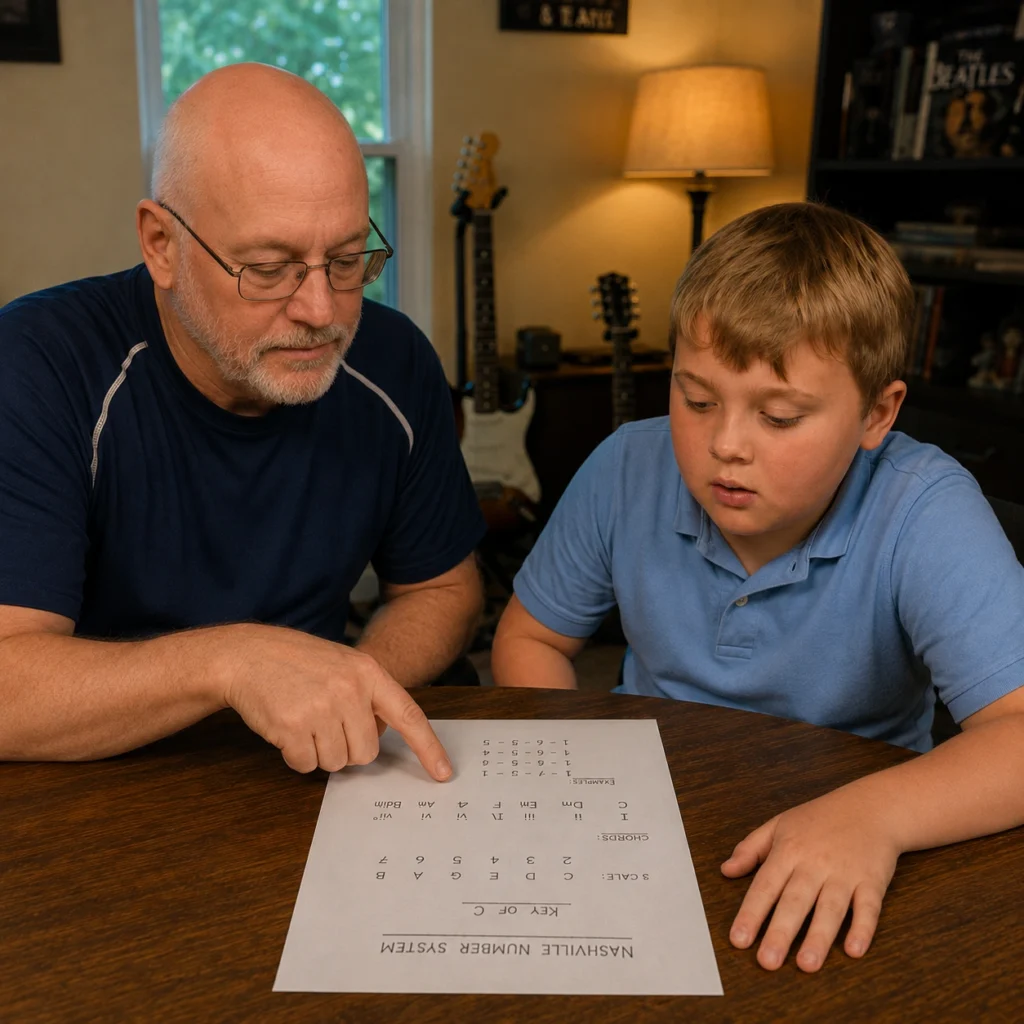
The Nashville Number System, also called the Nashville Numbering System, replaces chord letter names with numbers that stand for scale degrees. The first chord in a key is 1. The fourth is 4. The fifth is 5. Minor chords get a lowercase m, so the sixth minor chord is written 6m. A flat symbol in front of a number lowers that chord a half step.
Neal Matthews Jr., a singer with the Jordanaires, worked the system out in the late 1950s so the group could handle vocal arrangements quickly in the studio. Charlie McCoy later adapted it for rhythm section chord charts in the 1960s. Chas. Williams compiled and published it in book form in 1988.
The reason Nashville session players still use it is simple. A chart written in numbers works in any key. If a singer needs a song moved up a step, nobody rewrites anything. The band starts on a different root and the numbers stay exactly where they were.
Tab cannot do that at all.
What the number system does not do is show you fingering. It assumes you already know your chord shapes in whatever key gets called. It also does not spell out lead lines the way tab does. It handles harmonic structure, not note-by-note picking.
If you want the full walkthrough of how the system works, I break it down in plain language in my guide to the Nashville Number System.
Comparing the Three Systems Side by Side
Here is how guitar tab, the Nashville Number System, and standard notation stack up across the things that actually matter to a working guitarist.
Feature | Guitar Tab | Nashville Numbers | Standard Notation |
Shows finger placement | Yes | No | No |
Transposes without rewriting | No | Yes | No |
Teaches how music works | No | Yes | Partially |
Works for any instrument | No | Yes | Yes |
Shows exact rhythm | Rarely | Limited | Yes |
Theory knowledge required | None | Some | Most |
Used in Nashville studios | Rarely | Yes | Rarely |
No system wins every column. A player who only knows tab is stuck the moment the key changes. A player who only knows numbers still has to know chord and scale shapes on the neck. A player who reads standard notation has the most complete picture and spent the most time getting there.
Things Worth Knowing
- The Nashville Number System was built for chord charts, not lead lines. It tells a rhythm player what harmony to play, not which notes to pick.
- Tab only works on fretted instruments. Bass players use it too, but a keyboard or horn player cannot read it at all.
- Number charts do carry some rhythm information through diamonds, pushes, and split bars, but not with the precision of standard notation.
- You do not need to read sheet music to play well in a band. Plenty of working musicians never learn it.
- Knowing both tab and the number system makes you more useful, especially if you play with different bands or in different keys.
Start Learning Lead Guitar by the Numbers
You do not have to pick one of these forever. Learn both over time. But if you are a complete beginner who wants to play electric lead guitar and understand what you are doing while you do it, starting with the number system gives you a foundation tab cannot provide.
That is why I wrote Thadeus Beginning Electric Lead Guitar Featuring the Nashville Numbering System. It is a 128-page course for players starting from nothing, covering the A major scale in all five fretboard positions, the chords in the key of A across those positions, arpeggios, third and sixth harmonies, and how to move everything you learn into any other key. I originally wrote it as lessons for my oldest grandson, Thadeus, and it grew from there.

Frequently Asked Questions
Q: Should a beginner guitarist learn tab or the Nashville Number System first?
Both have value, and they teach completely different things. Tab gets you playing specific songs faster because it needs no theory at all. The number system takes a little more upfront work and teaches you how music is put together, which is what lets you play with other people and handle key changes without panicking.
Q: Do I need to read sheet music to play guitar in a band?
No. Most working guitarists never learn standard notation. Tab and number charts cover almost everything a band guitarist runs into. Notation matters in orchestral, classical, and formal ensemble settings, and most rock, country, and worship players get along fine without it.
Q: Can you use guitar tab and Nashville numbers together?
Yes, and a lot of players do. You might learn a specific lick note for note from tab, then use a number chart to see where that lick sits in the harmony of the song. The two cover different ground and work well side by side.
Q: Why do session musicians use number charts instead of sheet music?
Number charts are faster to read, faster to write, and they transpose instantly. In a session, a producer might call a new key between takes. A number chart needs no rewriting, because the numbers describe relationships between chords rather than letter names. That saves time, and in a studio time is money.
Q: Is the Nashville Number System harder to learn than tab?
It has a slightly steeper start, because you have to understand scale degrees first. Most beginners are reading basic charts within a week or two. Tab is faster on day one, but the number system keeps paying off, because what you learn transfers to every key and every song you touch after that.
The Bottom Line
The Nashville Number System versus guitar tab is not really a competition. They solve different problems. Tab hands you a map of the fingerboard for one song in one key. The number system hands you a framework for understanding harmony that holds up in every key you will ever play in.
If your goal is playing with other musicians, adapting when the key changes, and actually understanding what is coming out of your amp, the number system is the better foundation. Start there, add tab when you need it, and you will be ahead of where most self-taught players end up.
3 Responses