
What Is the Nashville Numbering System and Why Every Guitarist Should Know It
The Nashville Numbering System is a method of writing chord charts using numbers instead of letter names, so a song can be played in any key without rewriting anything. Instead of writing “G, C, D,” you write “1, 4, 5,” and those numbers work in every key on every instrument.
Where the Nashville Numbering System Came From
The system originated in Nashville, Tennessee in the 1950s. Neil Matthews, a bass player and studio musician, developed it as a practical shorthand for busy recording sessions where musicians needed to learn songs fast and shift keys on the fly. It was later compiled and published in a book by Chas. Williams in 1988.
Nashville session players adopted it quickly because studio time is expensive and nobody wants to stop a take to rewrite a chart. If a singer needs the song moved up a half step, the bandleader calls the new key and everyone keeps going. The numbers stay the same. Only the starting point changes.
The system started in country and gospel circles, but it spread. Today you’ll find it used in pop, rock, worship, and jazz settings too. It’s a favorite tool for session musicians, songwriters, and producers who need a common musical language that anyone can follow.
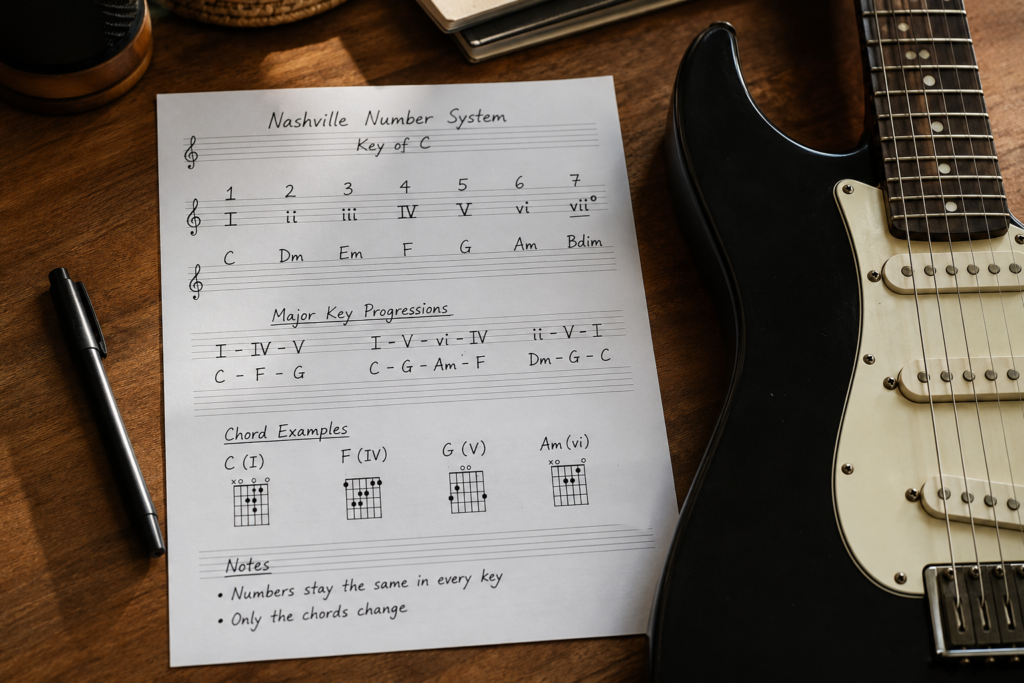
How the Numbers Work
Every major scale has seven notes. In the Nashville Numbering System, each note gets a number from 1 to 7, and the chord built on that note gets the same number.
Here is what that looks like in three common keys.
| Number | Key of G | Key of A | Key of C |
|---|---|---|---|
| 1 | G | A | C |
| 2m | Am | Bm | Dm |
| 3m | Bm | C#m | Em |
| 4 | C | D | F |
| 5 | D | E | G |
| 6m | Em | F#m | Am |
| 7dim | F#dim | G#dim | Bdim |
Look down any one column and you have that key. Look across any one row and you have the same chord function in three different keys. That is the whole idea.
A chart might show 1, 1, 4, 5 for a verse. You play those chords in whatever key gets called. No pencil, no rewriting, just a quick mental shift.
A few marks you will see on real charts.
- A lowercase m after a number means the chord is minor, like 6m.
- A flat sign in front of a number means that chord is lowered a half step, like b7.
- A slash shows a bass note under the chord, like 1/3.
- Numbers grouped in a bar mean they share that measure, so 1 4 inside one bar is two beats each in 4/4.
Once the pattern clicks, you can read a chart cold and keep up with a working band. I walk through this piece by piece in Thadeus Beginning Electric Lead Guitar Featuring the Nashville Numbering System, alongside the lead technique you will need to actually play the parts.

Why You Should Learn It Now, Not Later
Most beginners learn songs by memorizing chord shapes in one key, usually straight off a tab sheet. That gets you pretty far. Then somebody asks you to play the same song a whole step down, or you sit in with a band that runs everything by ear, and the whole approach falls apart in about four seconds. If tab is all you have used so far, it is worth understanding the difference between number charts and tab before you go much further.
Learning the numbering system early saves you from rebuilding your musical thinking later. It trains your ear to hear the relationship between chords instead of the names of chords. Going from the 4 to the 5 chord sounds the same no matter what key you are playing in. Once you hear it that way, you can figure out most of a song after one listen.
That skill carries into every style you will ever play. It is also the difference between a player who gets called back and a player who does not.

Things Worth Knowing
- Minor chords are written with a lowercase m after the number, like 6m.
- You can call a chord change across a loud stage just by holding up that number of fingers, which is half the reason the system caught on.
- Worship bands lean on number charts almost exclusively, because the key changes week to week depending on who is singing.
- The system is not the same as Roman numeral analysis, even though both count scale degrees. More on that below.
- Learning your chord shapes in three or four keys first will make number charts much easier to read at speed.
Ready to Start Reading Charts?
Grab a copy of the book on Amazon and work through the number system next to your first lead guitar lessons. That combination gives you the technique and the language at the same time, which is the order I wish somebody had taught me in.
You can also join the mailing list for new lessons and practice material as I put them out.
Frequently Asked Questions
Q: Do I need to know music theory before learning the Nashville Numbering System?
No. The system is built to be readable by complete beginners. You learn the scale degrees by number and start applying them to songs right away, and the theory understanding builds itself in the background while you play.
Q: Does it work on guitar, or is it mostly for piano and bass?
It works on any instrument. It came out of vocal and session work and got picked up by guitarists, keyboard players, bass players, and drummers alike. If you know your chord shapes in a few keys, you have everything you need to start.
Q: How is it different from Roman numeral analysis?
Both count scale degrees, but they are built for different rooms. Roman numeral analysis is a classroom tool for analyzing music after the fact. The Nashville system is built for live playing, so it uses plain numbers, writes faster, and reads at a glance in a dim studio or on a stage. Roman numerals are more formal and slower to process under pressure.
Q:What does a real number chart look like?
A row of numbers for each section of the song. A verse might read 1 1 4 5 and a chorus might read 1 5 6m 4. Repeats, bar lines, rhythm marks, and dynamics get layered on top of the numbers as simple notation.
Q: How long does it take to get comfortable with it?
Most of my students read basic charts within a week and start hearing the numbers instead of counting them out within a month or two. The reading comes quickly. The ear part takes longer and is worth every bit of the wait.
The Bottom Line on What Is the Nashville Numbering System
The Nashville Numbering System is one of the most practical things a guitarist can learn, whether you are sitting in with a band for the first time or working a session where the key changes twice before lunch. It trades memorization for understanding, and it makes transposing feel ordinary instead of stressful.
Start with the basics. Learn your chord shapes in a few keys, get the 1, 4, and 5 under your fingers everywhere, and then start listening to songs and naming the changes by number as they go by. Do that for a few weeks and you will stop seeing chord charts the same way.